Get your brand recommended
inside ChatGPT
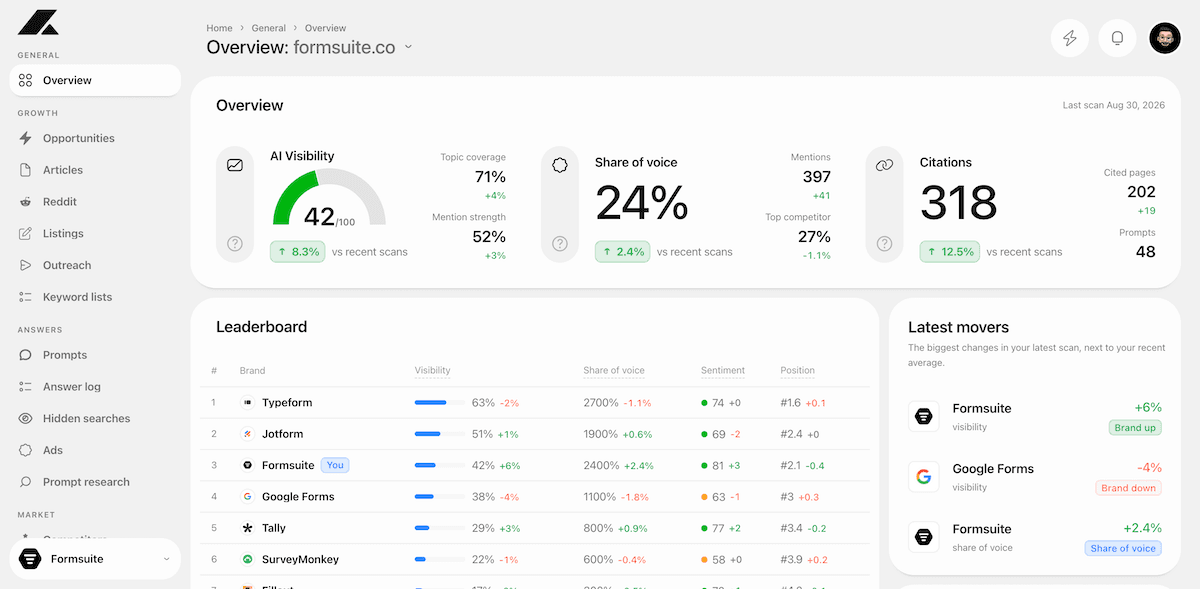
See the answers your buyers get and who gets named instead of you. Every gap becomes a ready-to-run action that gets you recommended, with the work already drafted for your review.
Receipts
Every answer kept in full, so every number can be traced to it
Sources
Every cited page captured, typed and ranked by what it costs you
Opportunities
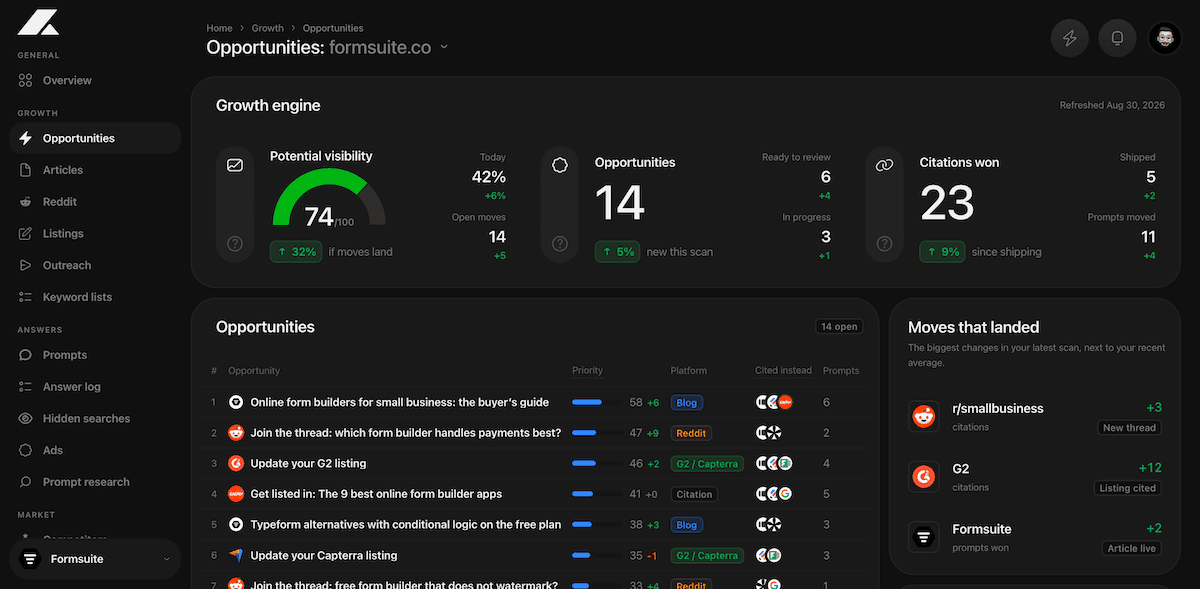
Every gap becomes a scored move with a brief attached
10 minutes
From sign-up to your first scan and your first board
From your brand to your next move
Tell us which questions matter. We ask every major AI assistant, read the answers back, and turn what we find into numbers you can trust and moves you can make.
Give us your brand, your market and your topics. We suggest the questions buyers actually ask assistants, with how often each one is asked. Keep the ones worth owning, edit them, or bring your own.
Each day we ask every major assistant your questions and keep the full answers. You see who was recommended, how you were described, which pages were cited, and what moved since yesterday. Competitors you did not know about show up on their own.
Each gap lands on one board as a scored opportunity with a brief, aimed wherever the engines actually get their answers: your own site, and the communities, directories and publications they cite. Pick one and the work is drafted from the evidence, ready for your review.

What other AI search platforms leave out
Thousands of answers, sources and searches, turned into a picture you can read in a morning. All of it feeds the moves on your board.
The answers your customers actually see
Where an engine has a real app, we read it there with our own browsers, the way your buyers do, rather than an API shortcut that quietly returns something else. Same wording, same order, same links, same sponsored slots. Every number in the product opens into the answer that produced it.
best analytics platform for a small ecommerce team
For a small ecommerce team, a few tools stand out depending on what you need most:
Northlane is usually the best starting point.[1] Setup takes minutes and the reporting is built around revenue rather than pageviews.[2]
Everline is a strong alternative if you already run a warehouse,[3] and Portside is worth a look at higher volume.
Cited sources
3The searches behind the answer
Before an engine replies, it quietly runs its own searches and reads whatever comes back. We capture those, so you can see the questions it asked itself, and whether they mentioned you, a rival, or nobody in particular. When we draft an article for you, those questions become its headings.
Searches captured
4,912
best ecommerce analytics tools 2026
northlane pricing
everline vs northlane
shopify analytics app reviews
ecommerce attribution software
northlane vs GA4
Where the answers come from
Engines do not invent a recommendation, they read pages and summarise them. We keep every page they read, group it by site, and rank the ones sending your competitors into answers you never appear in. Those pages become the outreach, listing and thread work on your board.
Retrievals
4,234
g2.com/categories/ecommerce-analytics
reddit.com/r/ecommerce
capterra.com/ecommerce-analytics
shopify.com/partners/directory
Ads inside AI answers
Paid slots are turning up inside ChatGPT answers. Because we read the real app, we can show you who is buying them, on which questions, and whether anyone is paying to appear beside your brand. Only placements we actually saw, never ones inferred.
best ecommerce analytics tool
A few options are worth comparing depending on your stack:
Revenue attribution for growing stores. Free 14 day trial.
Ads seen
218
Advertisers
14
Coverage
26%
Answers change by country
Ask the same question in Berlin and Boston and you get different brands. We ask from the market you sell in, so the answers are the ones your buyers there are really getting.
Region is a real engine parameter, not a filter applied afterwards.
Every gap becomes a move you can make this week
AI assistants recommend what they read. Recited finds the pages, threads and listings behind your competitors’ mentions and hands you the work that puts you there.
Know what to do, and why, before you start
Every opportunity opens with what you need to decide in a minute: the questions it answers, who is being recommended instead of you, what the winning page does well, and a ready-made brief with the angle and the outline. No research session, no blank page.
Priority
Visibility
Cited instead
Prompts
- 1Which analytics tools do Shopify stores actually use?H2
- 2Is GA4 enough for an ecommerce store?H2
- 3What does revenue attribution cost to set up?H2
- 4How the tools compare on channels, cohorts and priceH2
Articles on your site
Answer-first pages drafted from the questions you lose
Community threads
Reddit and forum threads the engines already cite
Directory listings
Review sites the engines quote when they compare tools
Pages to get onto
Roundups and guides that rank your rivals and not you
Not every gap needs a blog post
Sometimes the fix is a page on your site. Sometimes it is a reply in the thread assistants keep quoting, a listing that finally says what you do, or an email asking to be added to the guide everyone cites. Recited picks the move that fits the gap and drafts it, so your effort goes where it pays.
Articles
Answer-first articles for the questions you are losing, drafted from the answers your buyers actually see and reviewed to read like a person wrote them. Edit in the app, publish anywhere.
Learn moreCommunity threads
The Reddit and forum threads assistants quote when they recommend your competitors, with a reply that helps the person asking. You post it from your own account.
Learn moreDirectory listings
Listing copy for the review sites assistants use to compare tools, written around what buyers in your category are asking for. Paste it in, and the next scan tells you if it got cited.
Learn moreOutreach
The roundups and buyer's guides that rank your rivals and leave you out, with a short pitch to the author and the proof that you belong on the list.
Learn moreAn article builder made for AI answers
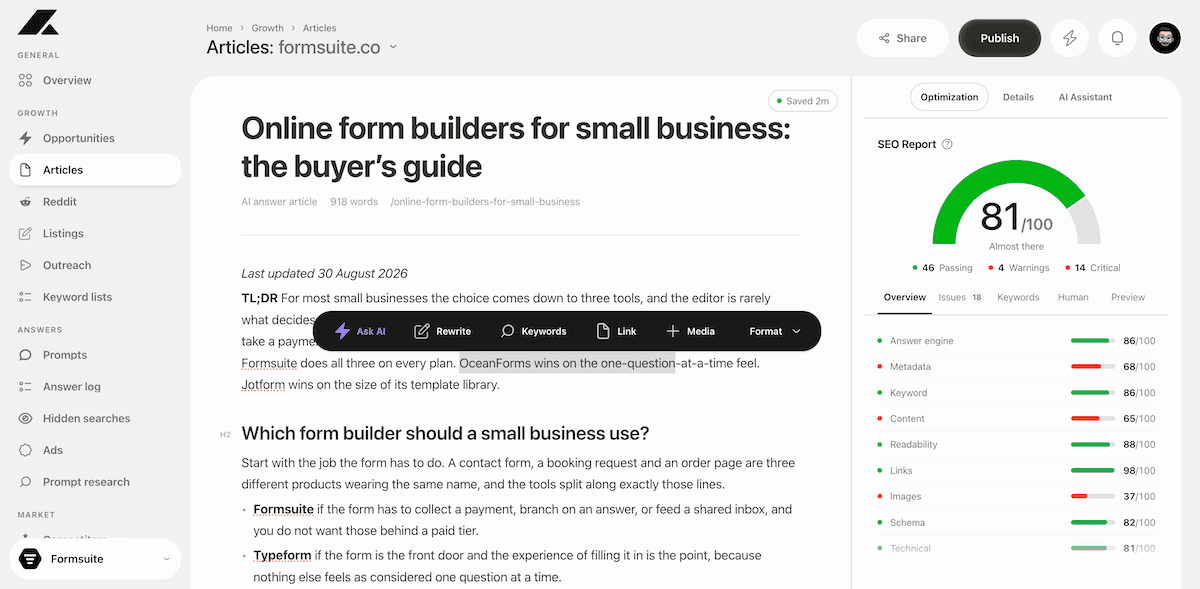
From brief to published page without leaving the app. It drafts from the answers your buyers see, audits itself for what gets cited, takes instructions in plain English, and writes like a person.
Audited for answers, as you write
Every draft is checked against what makes a page citable: the answer up front, question-led sections, a source behind each claim. Fix what it flags, or let it fix the draft for you.
Talk to it
Ask for a rewrite, a tighter opening, a new section or a source, in the editor or on a highlighted line. It knows the article, the brief and the answers it came from.
Edit like a document
A clean, block-based editor that feels like the tools your team already writes in. No markdown wrangling, no CMS forms, nothing to learn.
Reads like a person
Drafts are written and reviewed against the signals AI detectors and readers both notice, then scored for human quality. They pass the detectors we test against, and they read like you.
Every prompt, every scan, across every major platform
Whoever owns this in your company
One scan, read a different way depending on who opens it.
The work is the same. The scoreboard changed.
Content, PR and technical fundamentals still decide whether you get recommended. Only the way you measure it has to change.
Read the actual answer
Every number opens into the response the engine gave, with your brand, the competitors and every citation marked up. No metric you have to take on trust.
A score with a formula
Visibility is topic coverage and mention strength, weighted and published. You can recompute ours by hand, which matters the first time someone senior asks where the number came from.
Make the shortlist
An answer names two or three brands, not ten links. Share of voice tells you how often you are one of them, and who takes the slot when you are not.
Know where to spend
Every day ends with a board of scored opportunities, each one carrying the answers and competitor pages that make the case. No research session to start one.
See past the answer
The searches an engine ran before replying, and who paid to appear beside you. Most tools stop at the text and miss both.
Ends in a draft, not a discussion
Most tools stop at the dashboard. Here every finding becomes the actual work: the article, the reply, the listing or the pitch, drafted from the evidence and waiting for your review.
Everything your brand needs to get recommended
Every plan includes the full analytics and the full growth engine: articles, threads, listings and outreach. Price only changes how much of your market you watch.
Launch
One brand, one market
$Billed monthly
Scale
Growing teams with more to watch
$Billed monthly
Advanced
Multiple brands and markets
$Billed monthly
Frequently Asked Questions
The questions we get asked most on first calls. If yours is not here, ask us directly.